Building Joy at Home: The ABC’s of Parenting
Why do you do what you do as a parent?
Your parenting style didn’t come from a manual (probably). It likely came from your history and experiences. The way you were raised, the values you hold, and the daily stressors you face all influence your parenting choices (Coyne & Murrell, 2009).
If your child is being difficult while you’re juggling work emails, household chores, and dinner prep you might snap at them- understandably so. Scolding, reprimanding, and threatening loss of privileges does “work”- it gets the child to stop after all – and it’s probably worked for you before and for your parents before that. But it probably doesn’t feel great afterward- for you or them- and it can easily become the go-to response in an endless cycle of policing their behavior.
So what do you do instead? That’s where the ABC Model comes in. It’s a simple tool from behavioral science that helps us understand why behavior happens – both for kids and for parents. And the best part? Once you understand the ABCs, you can start shifting patterns in ways that align with your values and your vision for family life.
What is the ABC Model?
- A = Antecedent: What happens right before a behavior.
- B = Behavior: The action you can see, count, or time.
- C = Consequence: What happens right after the behavior.
Example #1: From the Parent’s Perspective
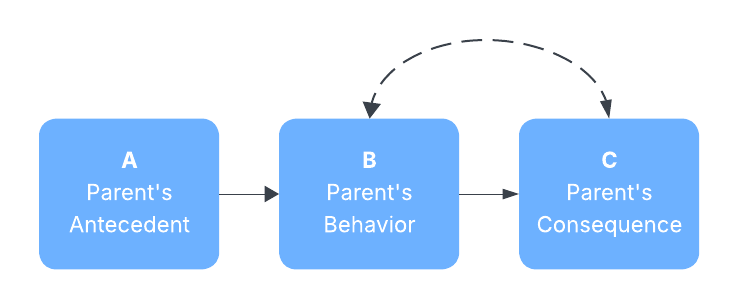
- A (Antecedent): You’re finishing up end-of-day emails. Your youngest child repeatedly interrupts and pouts while waiting for you.
- B (Behavior): You yell and send him away with toys.
- C (Consequence): You get quiet time to finish your task (short-term relief), but the cycle of yelling may continue tomorrow.

Results: the visual below illustrates the ABC model and shows how consequences can increase the likelihood of a behavior repeating in the future. Many families I’ve worked with have experienced similar scenarios and often share feelings of guilt after ‘lashing out. This is why it’s so helpful to understand the function of our behavior.
How Parent Behavior Shapes Child Behavior
The ABC model applies to kids and parents. Remember: behavior is learned. That means children often mirror what they see.
Example #2: How might your youngest child see it?
- A (Antecedent): Your child is excited to be home, but is bored while you finish up work.
- B (Behavior): Like any kid, they start nagging and pouting.
- C (Consequence): They get yelled at, yes, but also get sent away with some toys.
Now, in the future, they may be more likely to harass you while you’re working, because they’ll get something to do, but you’ll keep yelling at them because they keep nagging. It might also not stop here either:
Example #3 Your Eldest Child
- A (Antecedent): Their younger sibling is noisy, repeatedly asking for help, bringing out toys and making a mess.
- B (Behavior): The older sibling, after seeing you, yells at their brother/sister.
- C (Consequence): Their younger sibling runs away crying, the room is quiet.
Sure, maybe now mom gets to finish her work and big brother/sister isn’t being annoyed, but these situations feel a bit uneasy, don’t they?
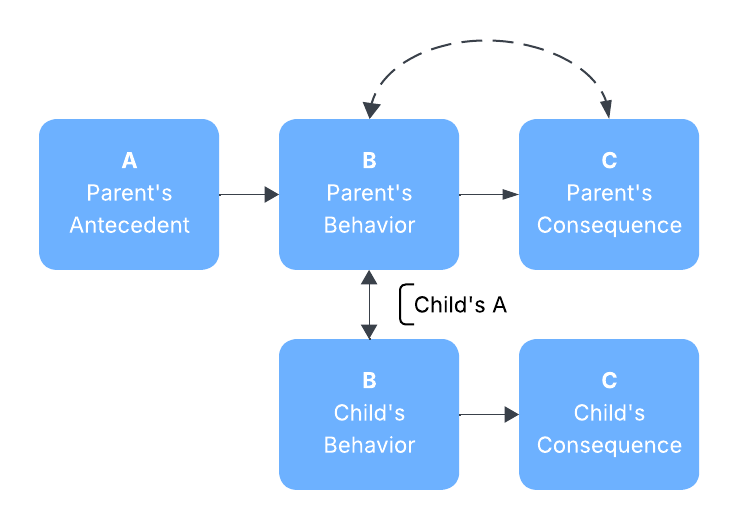
These patterns can start to impact the whole household. While yelling, punishment, or even merely distracting may “work” in the moment, it can become a vicious cycle. It can lead to tense situations and, perhaps most importantly, doesn’t show your child what they should be doing instead, while modeling behavior that your child and their siblings will pick up on. Critically, it might not be exactly what you envisioned yourself being as a parent.
Changing these sorts of patterns is not easy. It takes practice and support, but spotting causes of behavior and adjusting your behavior accordingly can help lead to equally effective strategies- especially those that are more in tune with your values as a parent.
Moving Toward Joyful Parenting
Parenting doesn’t have to feel like a tug-of-war. Parent-focused coaching can give you strategies that are:
- Effective in the moment
- Consistent with your long-term values
- Nurturing for your child’s growth
For some families, the starting point may be simply unpacking the ABC model together. For others, maybe they’re moving in the right direction but need help identifying core parenting values to guide their interactions. Either way, support from a professional can turn everyday stress into opportunities for connection.
Final Thoughts
Parenting is one of the most important and challenging jobs in the world. By understanding your own patterns, you can model the behaviors you want to see in your children and create lasting positive change at home.
We’re here to help. If you’d like to learn more about ABA based parent coaching, reach out and stay tuned – we’ll be sharing more practical tools and resources.
Thank you for reading! We’d love to hear from you and be a part of your community.
References
Bearss, K., Johnson, C. R., Handen, B. L., Butter, E., Lecavalier, L., Smith, T., & Scahill, L. (2018). Parent training for disruptive behavior: The RUBI autism network, clinician manual. Oxford University Press.
Coyne, L. W., & Murrell, A. R. (2009). The joy of parenting: An acceptance and commitment therapy guide to effective parenting in the early years. New Harbinger Publications.